How to Check Your Website's AI Visibility: What You Can (and Can't) Measure
A practical guide to what you can actually check yourself, what no outside tool can measure, and how to tell readiness apart from an actual AI mention or citation.
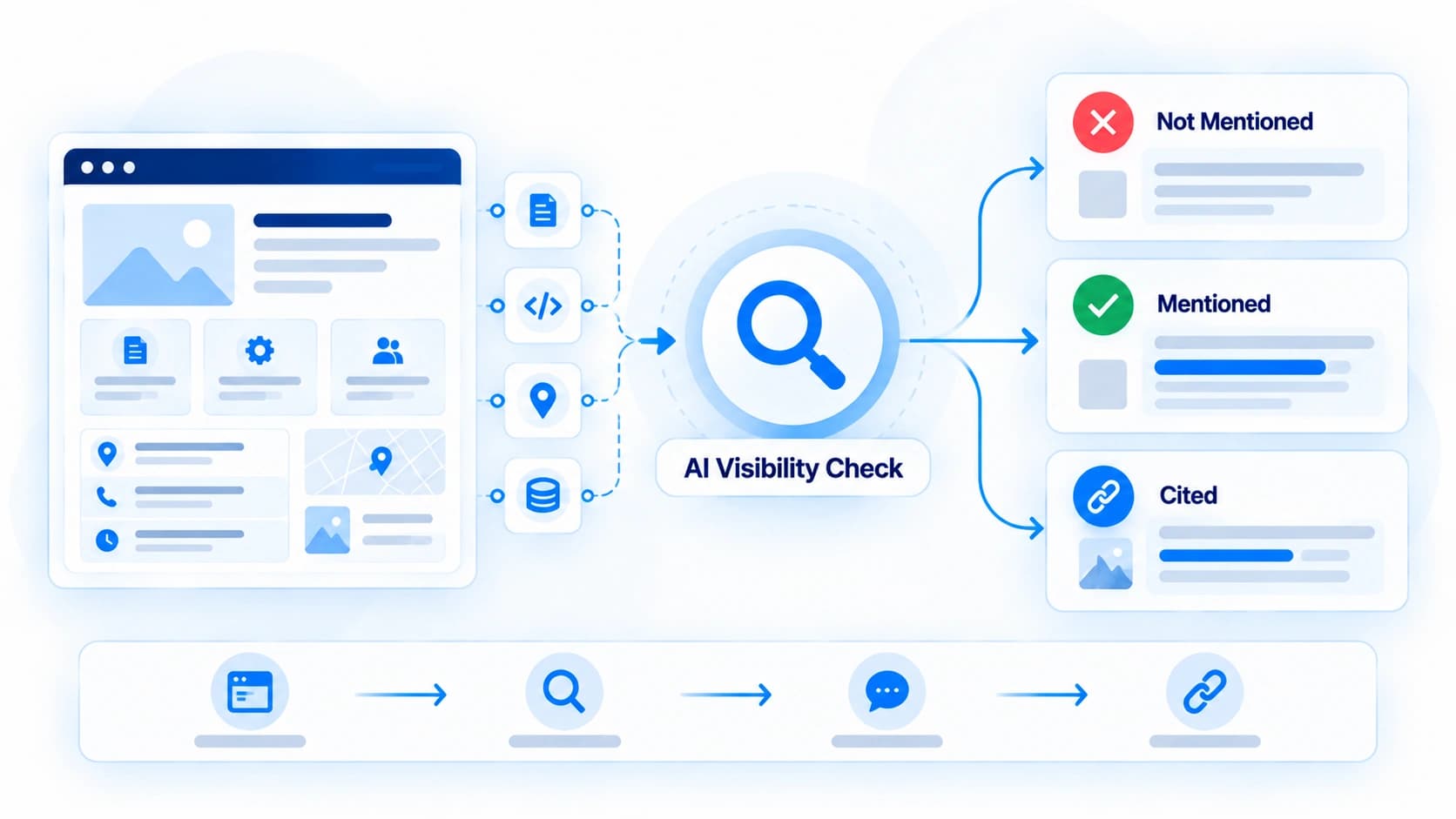
Ask ten marketers what "AI visibility" means and you'll likely get ten different answers. Some mean ranking inside ChatGPT. Some mean appearing in Google's AI Overviews. Others mean something closer to general brand awareness. Before you can check your own website's AI visibility, it helps to agree on what you're actually checking.
In practical terms, AI visibility describes how easily an automated system (an AI search assistant, an answer engine, or a retrieval-based chatbot) can find your website, understand what your business actually does, and treat your content as reliable enough to reference. It isn't a single score issued by one company. It's a combination of signals spread across your own website, and to a lesser degree, the web around it.
This article covers what "AI visibility" actually breaks down into, why a Google ranking alone won't tell you whether you have it, and a way to check your own website that holds up to repeating, not just a single one-off search.
What "AI Visibility" Actually Means
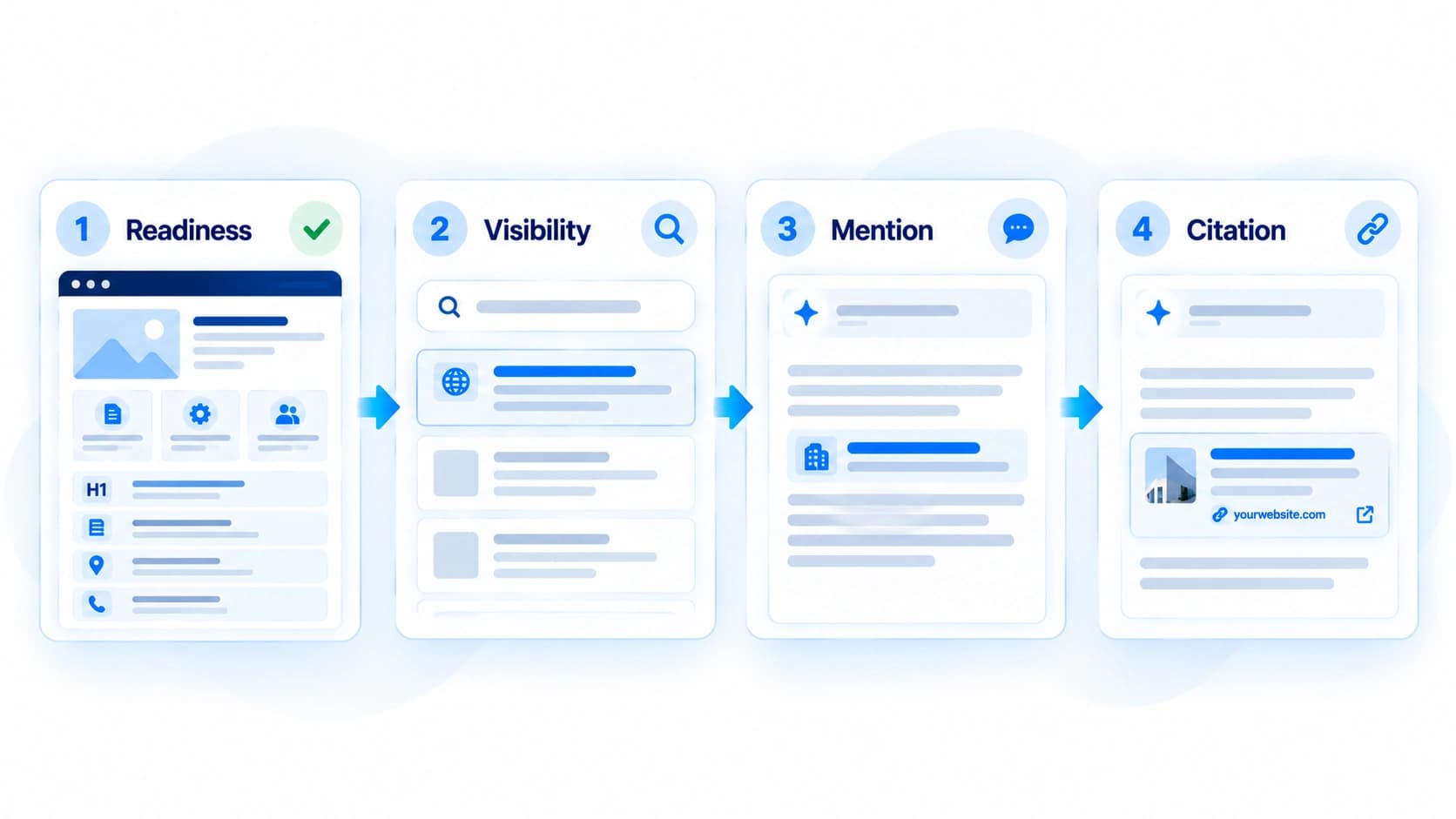
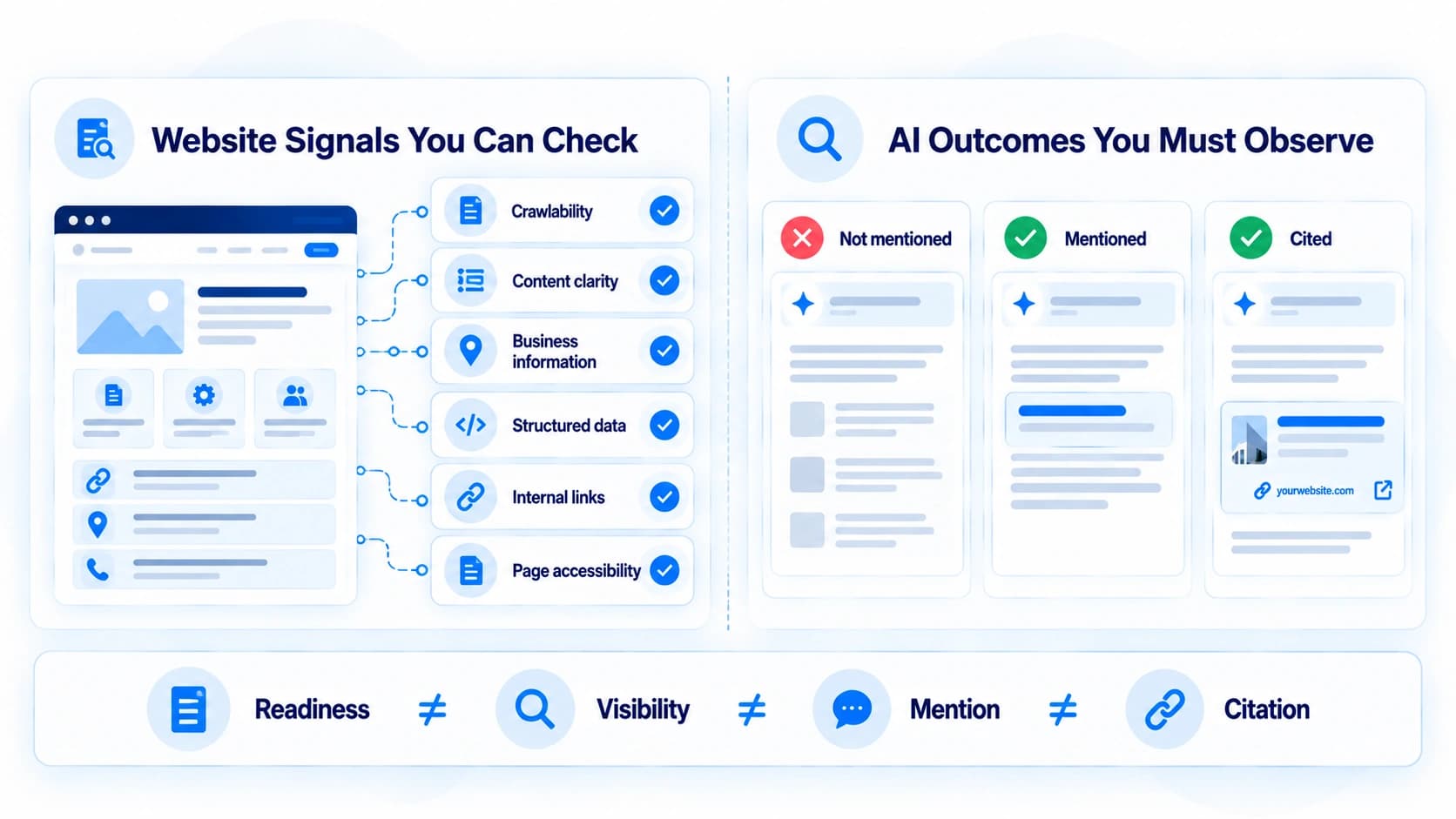
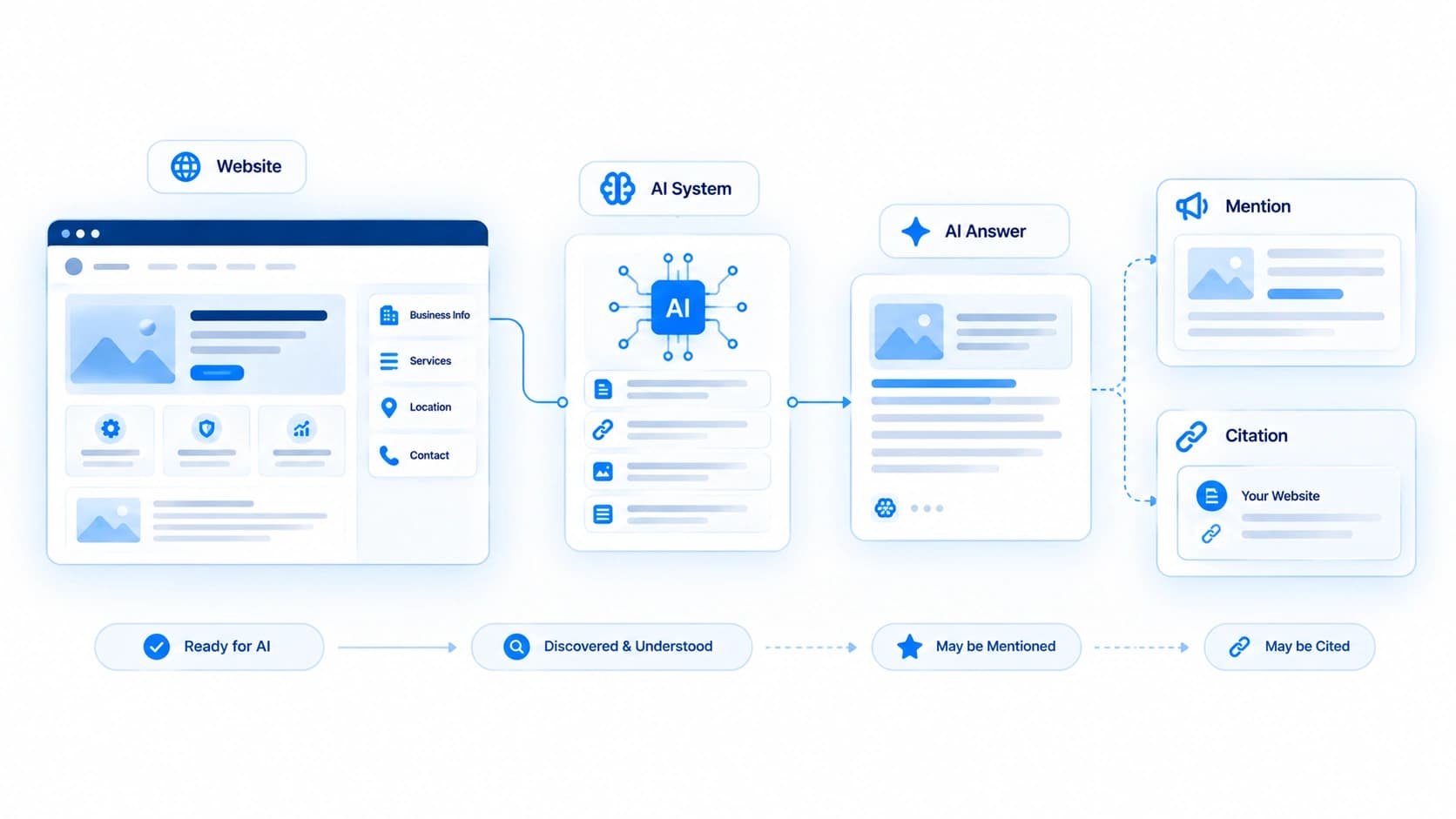
It helps to separate four related but different ideas: readiness, visibility, mention, and citation. Readiness, the term this article uses for what you can actually check, is whether your own website currently gives an automated system the clear, verifiable information it would need to use you as a source. Visibility is whether that system can find and correctly interpret your business information at all. A mention is when an AI-generated answer names your business, which shows it recognizes that you exist, without necessarily linking to your site. A citation is a specific answer actually naming or linking to your website as the source for a claim, a narrower, more specific outcome than any of the others.
Readiness is what you can control directly. Visibility is closer to a prerequisite than an outcome: a website can be highly readable, well-structured, and easy to parse, and still not get mentioned in one specific AI-generated answer, the same way a well-qualified job candidate can submit a strong application and still not get an individual offer. Mentions and citations are decisions an AI system makes, one answer at a time, and no outside party, including this article, controls or can fully explain them.
Readiness is what you can check and improve on your own website. Mention and citation are decisions an AI system makes, one answer at a time, based on the current query.
Why a #1 Google Ranking Doesn't Tell the Whole Story
Traditional search ranking draws heavily on signals like backlink profiles, domain age and authority, historical click behavior, and keyword relevance measured across an entire page or site. Those signals answer a specific question: which pages have earned enough trust and relevance to deserve a top spot for this keyword, over time.
AI answer engines are often solving a different problem for a different moment: given this specific question, which passage of text most directly and unambiguously answers it? A page that has earned a #1 ranking through years of backlinks and broad topical authority can still lose out to a lesser-known page if that page states the specific fact more plainly. The reverse is also true: authority helps a system decide which candidate sources to trust more when facts conflict. Google itself has said its own AI-powered search features are rooted in the same core Search ranking and quality systems, not a separate algorithm, though that's specifically a statement about Google's own AI Overviews and AI Mode, not a claim about how other providers work.
| Traditional Ranking Signal | What It Measures | Why AI Answer Engines May Weigh It Differently |
|---|---|---|
| Backlink profile | How many other sites link here, and how authoritative they are. | Useful for trust, but doesn't tell the system whether THIS page states the specific fact clearly. |
| Domain age and authority | How long the domain has existed and its general topical trust. | A newer, more specific page can still be selected if it's the clearest source for a narrow question. |
| Keyword density | How often a term appears across a page. | Generative systems generally parse semantic meaning and explicit facts rather than term frequency. |
| Content freshness | How recently a page was updated. | Matters for time-sensitive queries, but doesn't substitute for clear, specific evidence. |
The Signals That Actually Affect AI Visibility
Set aside ranking mechanics for a moment. A handful of concrete, checkable signals are common to websites that are easy for automated systems to interpret: a consistently stated business entity (name, location, and contact details, matching across the page, your structured data, and the external profiles you control), specific rather than abstract service descriptions, structured data that mirrors the visible text instead of replacing it, pages that return real content without requiring scripts to render, and independent sources that corroborate what the site itself claims.
None of these signals is exotic or requires special tools to understand, and the mechanics of each one are covered in more depth elsewhere on this site. What they require here is a deliberate, consistent check, which is what the rest of this article covers, along with what a check like that can't promise you.
Running the Check Consistently
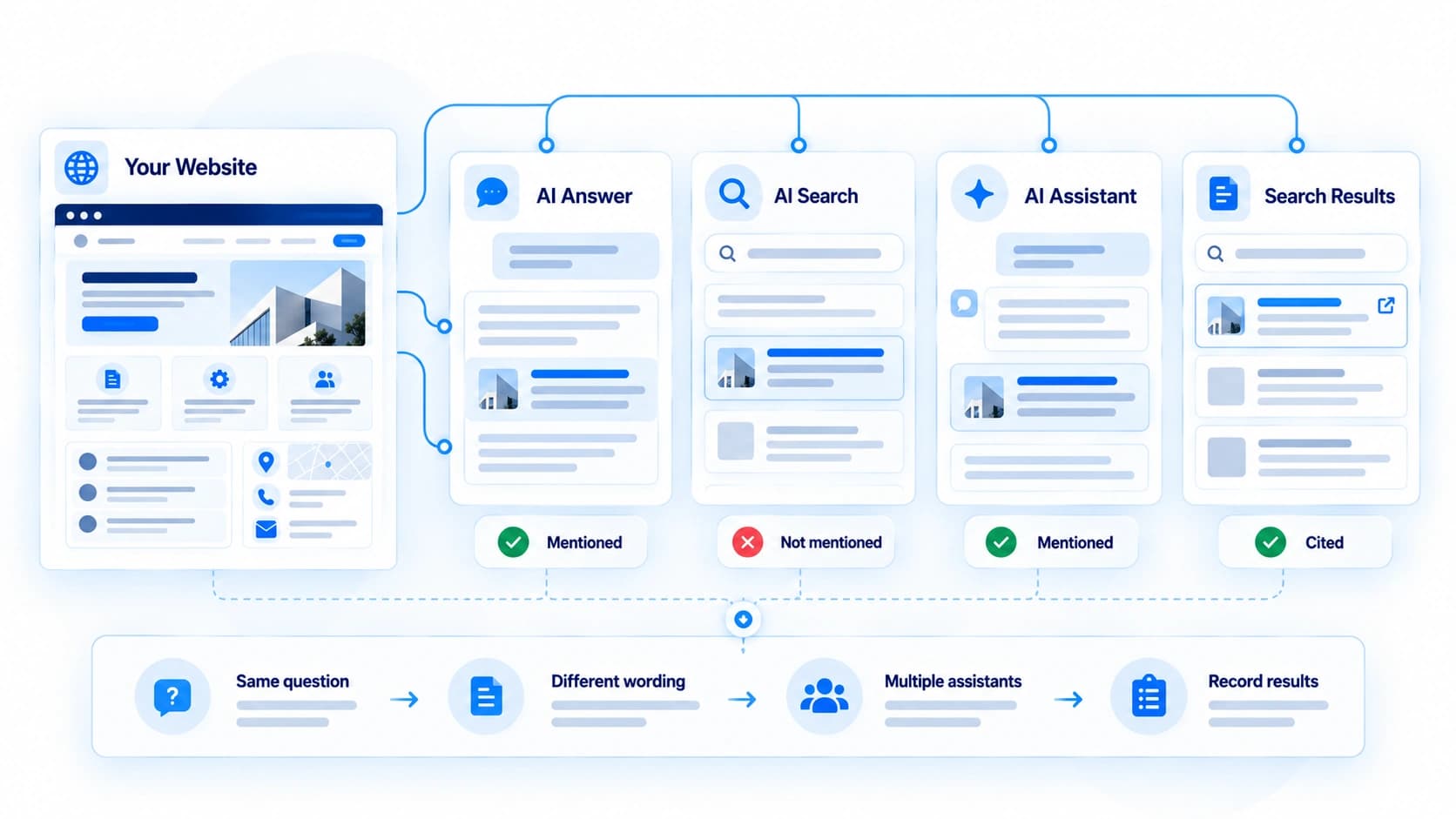
A single AI search proves very little on its own: it's weak evidence at best, and repeated observations across different phrasings and assistants give you a far more useful pattern. The useful version of this check follows the same few steps every time:
- 1. Pick three to five real questions a customer might actually ask, in your category and location, not a single generic search.
- 2. Ask each question with two or three different wordings. Phrasing changes what a retrieval system treats as a match, even when a person would read the variants as identical.
- 3. Run the same set across the AI assistants and search experiences you'd realistically expect a customer to use, not just one.
- 4. For each result, record whether your business was not mentioned, mentioned by name, or cited with a link, and whether the AI's description of your business is actually accurate.
- 5. Log the exact query, the assistant, the date, and the result somewhere simple; a spreadsheet row is enough. Without a record, it's easy to misremember a one-off result as a trend.
- 6. Recheck after a meaningful change (new copy on a core page, a fixed robots.txt rule, added structured data) rather than every day. Third-party corroboration and technical access can also shift without you touching your own site, so an occasional recheck without changes is reasonable too.
- 7. Judge the pattern across repeated checks over time, not any single response. A handful of checks can't rule out a different result on a different day; a consistent pattern across many checks is what's actually worth acting on.
Where a Dedicated Scan Fits In
Manual checks are genuinely useful, but they're also slow to repeat consistently by hand. That's the specific gap a dedicated scan like AI Citation Analysis's is built to close: it checks the same underlying signals (entity consistency, content specificity, trust indicators, and crawl access) across the five categories of its own C-I-T-E-D framework. That framework is the product's scoring system, not an industry standard, and it gives you a repeatable readout instead of a one-off manual pass.
It's worth being precise about what a tool like this does and doesn't do. It doesn't query ChatGPT, Perplexity, Gemini, or any other assistant, and it can't tell you whether one of them has actually mentioned your business; that's still the manual check above. What it can do is show you, objectively, whether the underlying evidence on your own website is currently clear enough for any of them to use.
Frequently Asked Questions
Does a high AI visibility score guarantee that ChatGPT or Google AI Overviews will mention my business?
No. It means the readiness signals on your own website are in good shape. What any specific assistant does with a specific query is outside what any outside tool can promise.
How often should I check my AI visibility?
Whenever you make a meaningful change to your site's copy, structure, or contact details, and periodically otherwise, since third-party corroboration and technical access can change without you touching your own site.
Is AI visibility the same thing as SEO?
They overlap but aren't identical. Traditional SEO optimizes primarily for ranking in a list of links. AI visibility is closer to entity clarity and evidence quality, the raw material an automated system needs to understand and trust your business in the first place.
Can I check whether ChatGPT specifically mentions my website?
Only by asking it yourself and reading the answer. OpenAI documents its crawlers, including which ones affect ChatGPT search, but doesn't publish a report showing which sites ChatGPT has mentioned or cited in a given answer, so repeated testing, by hand or with a third-party prompt-monitoring tool, is currently the only way to observe it.
Does Google Search Console show AI visibility?
It shows something related but narrower. Search Console's generative AI performance report gives impression counts for your pages inside Google's AI Overviews and AI Mode specifically. It doesn't cover ChatGPT, Perplexity, or any other provider, and it reports impressions, not clicks, for those surfaces.
Final Takeaway
AI visibility isn't a mysterious score you either have or don't. It includes website signals you can inspect directly, external evidence that can corroborate those signals, and the separate question of whether a particular AI system actually mentions or cites your business, something no outside party, including this article, can promise you'll see.
What a single manual check won't give you is a reliable baseline. A dated record, repeated over time and after real changes, and a repeatable scan to catch what's easy to miss by hand, are what actually let you tell a pattern from noise.
Sources
- AI features and your website · Google Search Central
- About the generative AI performance report · Google Search Console Help
- Overview of OpenAI's crawlers · OpenAI